

They Are Not Ready to Buy a Yacht Today. What Happens Next?
25 October 2026
When a Broker Leaves, Does the Client’s History Leave Too?
25 October 2026
“Every yacht is for sale” can be a useful starting point for thinking about a yacht’s long commercial life. A vessel that is part of an owner’s cruising programme today may become the subject of a sale discussion when requirements change. A different yacht, a new pattern of use or another project may prompt that conversation.
Particularly above 30 metres, buyers look beyond length, cabins and machinery specifications. Alongside their own intended use, they want to understand how the yacht has been operated, what work has been carried out and how clearly its history can be explained. Design and experience are the visible expression of luxury; the answers to these questions help establish confidence during the buying process.
A brokerage’s relationship history needs a corresponding vessel history. If the knowledge gathered about a yacht disappears when a listing closes, the next ownership period begins with questions the business has already investigated.
A listing and a yacht have different lifespans
A listing describes an offering at a particular time. A vessel record brings together changes in name, flag, ownership, use and technical condition over time. Overwriting an earlier listing with today’s information when a second sale process begins makes those periods harder to distinguish.
A CRM can therefore maintain a vessel master record linked to separate listings and sales opportunities. Current marketing material can draw on that record, while a previous campaign’s asking price, photographs, scope of offering and discussions remain associated with their own period.
Knowing a yacht’s history when it is not being marketed is also part of a broker’s professional knowledge. That record does not establish current sale intent or authority to market the vessel. A decision to list or present it to a buyer needs separately confirmed status and authority.
Which record carries the history when the name changes?
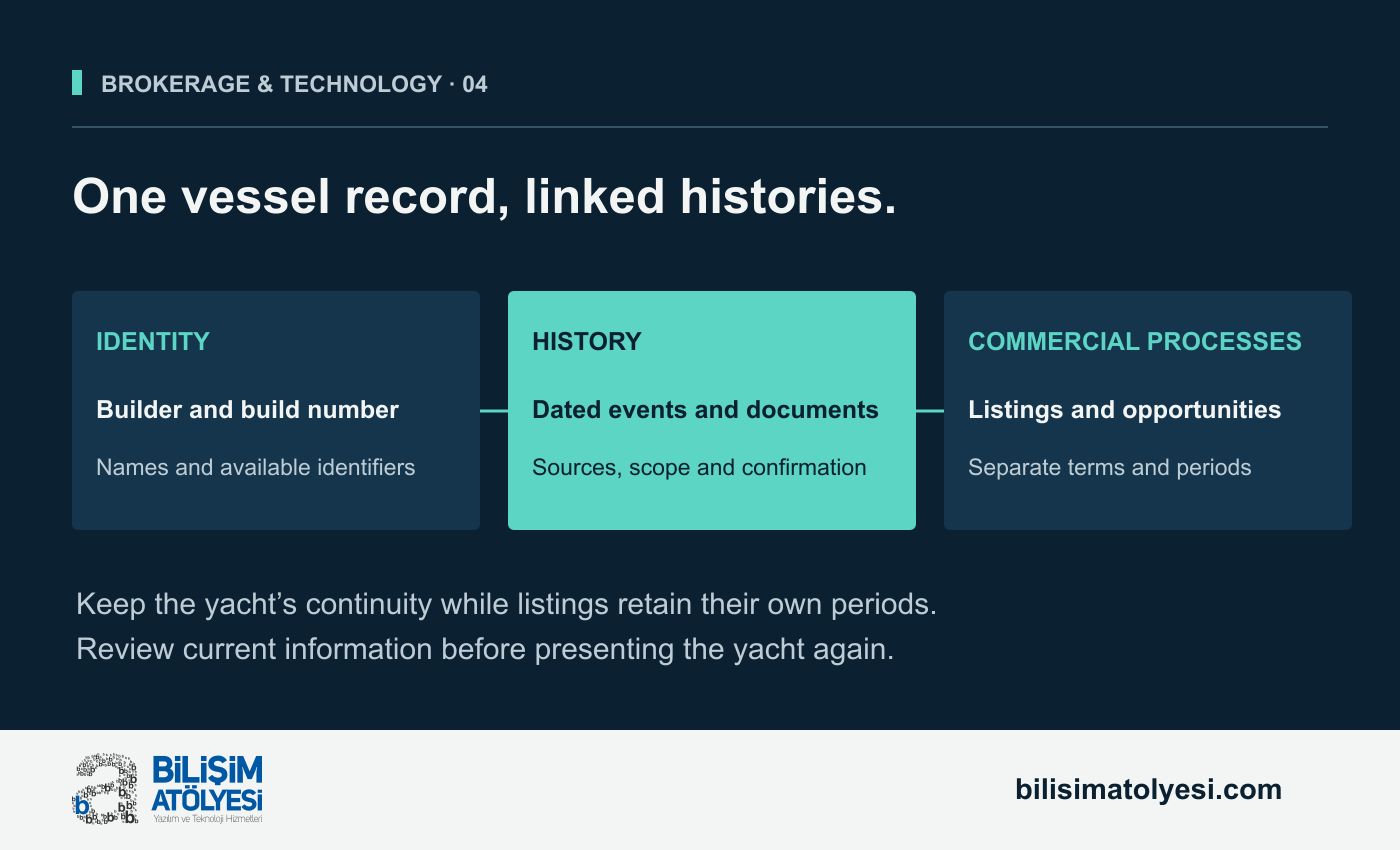
A yacht’s name alone is an unreliable matching key. Different yachts may share a name, while one yacht may be known by several names across ownership periods. The master record should consider the builder, build or hull number and available official identifiers together.
Previous names and flags can be associated with known date ranges. Where an IMO number has been assigned, it can be recorded. IMO explains that an assigned ship number remains unchanged through changes of name, flag or ownership. This is not a proposal to assume that every yacht has such a number.
Merging records before identity is established can attach one yacht’s maintenance or sales history to another vessel. Missing identifiers should remain visible as a matter for review. A similar name or photograph is not conclusive identification.
What does “refitted” leave unanswered?
Consider an illustrative scenario. A yacht the brokerage previously reviewed returns under a new name. Its presentation says “refitted”. The buyer’s questions immediately become more specific. When was the work completed, what did it cover and who carried it out? Was it an interior update, machinery and systems work, or both?
A useful record goes beyond that general label. It should make the scope of work, relevant yard or service provider, available supporting documents and latest confirmation date understandable together. If a survey finding was recorded, the relationship between that finding and a later repair or inspection should also be clear.
- What is known? The reported work, equipment replacement or condition examined is described specifically.
- What supports it? Service records, reports, invoices and statements from an authorised person are distinguished.
- How current is it? The date and scope of an earlier inspection remain visible rather than standing in for current condition.
Fraser’s buyer’s guide considers yacht history, expected maintenance and anticipated running costs during selection, and includes surveys and sea trials in subsequent checks. A CRM can make the information easier to retrieve. Relevant technical inspections establish the yacht’s present condition.
How does ownership history change a buyer’s questions?
Learning about an earlier ownership period may change how a buyer approaches the yacht. They may want to understand who was involved, how the vessel was used and how it was managed. The question “who owned it?” often accompanies another: “how was it looked after?”
An opinion about a former owner’s reputation and the yacht’s documented condition are different kinds of information. A well-known name does not guarantee condition; an unfavourable impression alone does not establish a technical defect. The broker needs to understand the specific question behind the buyer’s concern.
If there is a claim that maintenance was neglected, for example, the relevant period and source matter. Available records and any need for inspection can then be assessed. Passing an unverified rumour between records adds no dependable knowledge. Source, date and verification status are therefore important parts of the information model.
The registered owner, a representative acting for that owner, the captain, management company and broker authorised to market the yacht should also be recorded as distinct roles. Knowing who supplied information, in which capacity and during which period helps the team direct updates and questions to the right party.
Three prices should not become one historical figure
An asking price, an offer made on particular terms and a verified completed sale price are separate data points. Recording an online asking price as a previous transaction price introduces a false reference into later assessments.
The type of figure, currency, date and source should be visible. Differences in scope or delivery terms also matter to a comparison. Where the completed price is unknown, the gap should not be filled with a guess presented as fact.
Price information also needs appropriate access. Internal commercial assessments and information that may be shared with a buyer or listing channel can have different audiences. A master record does not require every field to become public.
A sale can start a separate purchase conversation
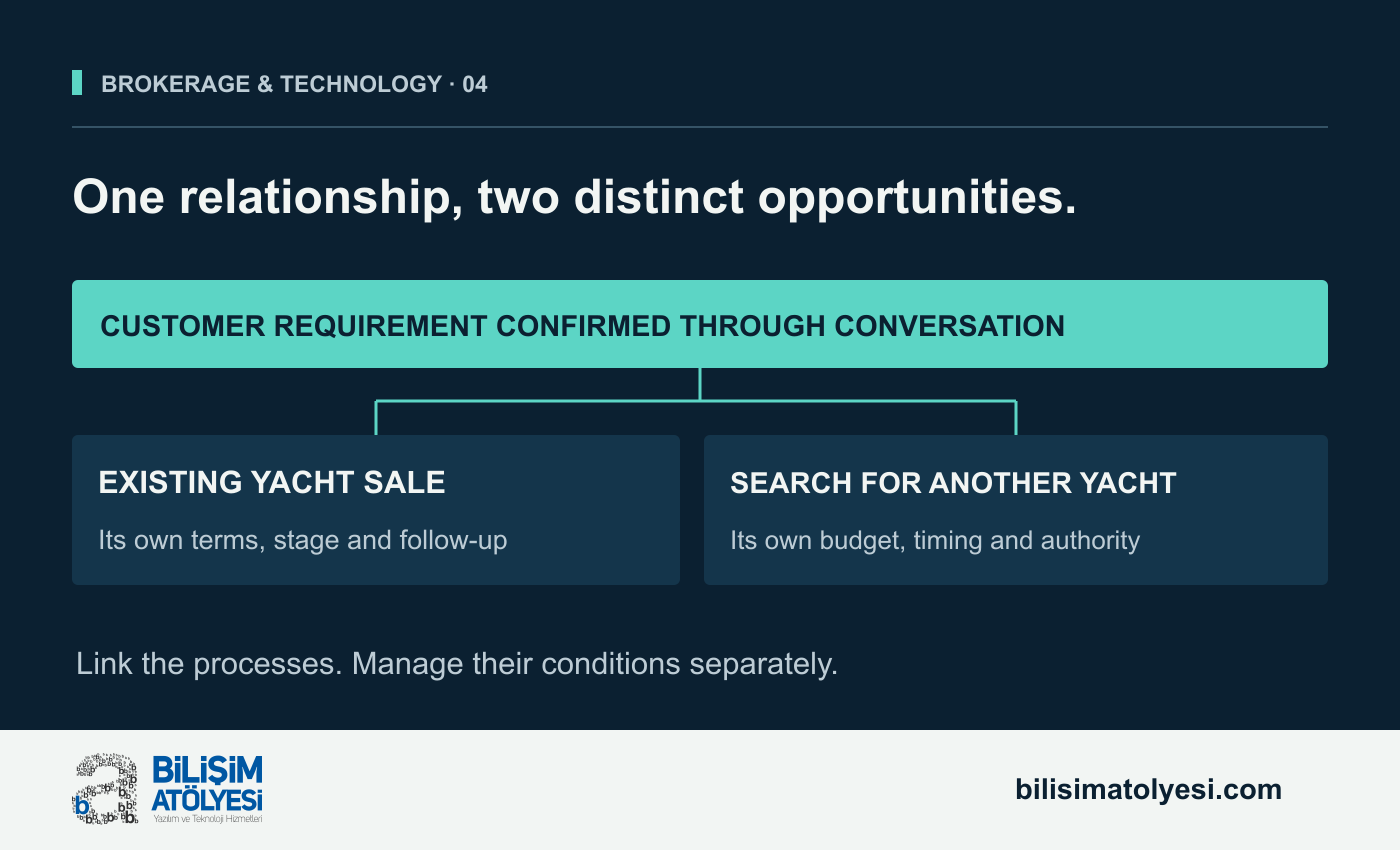
An owner considering the sale of their current yacht may also be researching the next one. When that relationship has been established through conversation, the CRM can link the current yacht’s sale opportunity to a separate buying brief.
The two processes still need their own budgets, stages, authority and timing. Whether the purchase depends on the existing yacht’s sale should reflect the conditions the person actually expressed. Owning a yacht does not by itself establish an intention or budget to buy another.
The broker can then see both the current vessel and the customer’s confirmed next requirement. One transaction may close while another discussion continues.
What should remain after the sale closes?
A completed sale does not require the vessel record to be deleted. The closed process can retain its outcome and period. An earlier ownership relationship can receive an end date, with a new relationship created only from confirmed information. Listing channels should reflect the updated sale status.
When the yacht becomes relevant again, the team should be able to retrieve current particulars, dated technical events, sources and earlier discussions as a connected history. Information that may have changed is rechecked. A previous owner’s private correspondence should not automatically become part of the vessel material supplied to a new buyer.
At Bilişim Atölyesi, we design yacht-sector CRM and listing infrastructure around the relationships between customers, vessels, documents, API integrations and sales operations. Depending on the project, vessel-record lifecycles, listing-channel updates and broker follow-up screens can be considered within the same system.
A broker’s accumulated knowledge also lives in the yachts whose histories they understand and keep current. Carrying that knowledge into the next conversation requires vessel history to be designed alongside customer history.
Discuss how your vessel records connect to your sales processes.
Previous article: They Are Not Ready to Buy a Yacht Today. What Happens Next?
All articles in Brokerage & Technology.