



When a Broker Leaves, Does the Client’s History Leave Too?
25 October 2026
Close to Your Boat, Even When You’re Miles Away
3 November 2026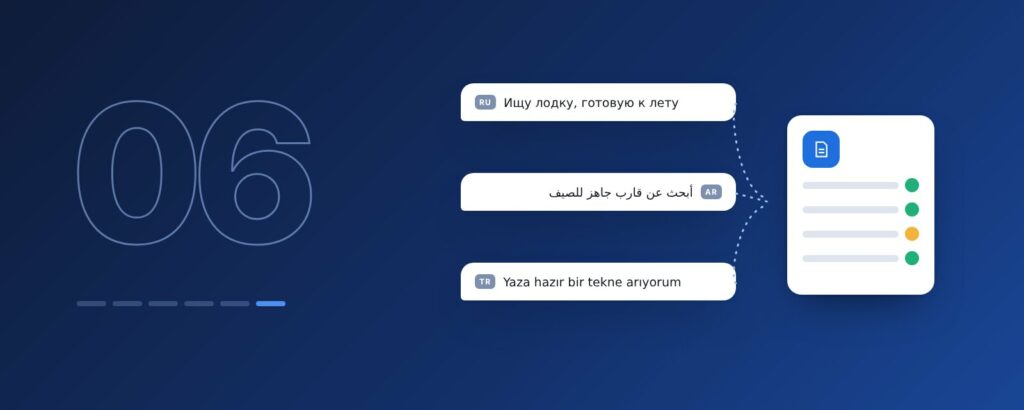
“I’m looking for a boat that’s ready for summer.”
You can translate this sentence from Russian, Arabic or Turkish into another language. But does the client want a boat delivered at the start of summer? A yacht with maintenance completed, ready to use right away? Or one that is ready in a specific country, in line with the cruising plan they have in mind?
The translation may be clear, but the commercial meaning of the request is still uncertain. A broker’s work continues after the words have crossed from one language to another. It is necessary to separate what the client said, what the team understood from it and which points are still awaiting confirmation. In a multilingual brokerage, the CRM’s contribution is to set up a record structure that makes enquiries arriving in different languages usable in the same decision process.
Russian, Arabic and Turkish enquiries can meet in the same structure
A web form may arrive in Russian, a lead form from an ad campaign in Arabic and a phone call in Turkish. Even if the team’s working language is English, the details each client expressed in their own language should be preserved. Translating all messages into one language does not, on its own, create a shared enquiry record.
A comparable record should show the boat segment sought, the intended use, the budget and currency the client expressed, timing, purchase conditions and the points that are not yet clear. These fields should be used with the same meaning regardless of the language the message arrived in.
Inferring budget or purchase intent from nationality, communication language or phone country code should not be part of this structure. The preferred language is learned from the client. The assessment of the need rests on the content of the conversation and on confirmed conditions.
Translation should not replace the original message
An enquiry record needs to keep four layers apart. The client’s original words, their translation in the working language, the broker’s commercial assessment and the confirmation status of that assessment. When doubt arises later, the team should be able to see which information a decision was based on.
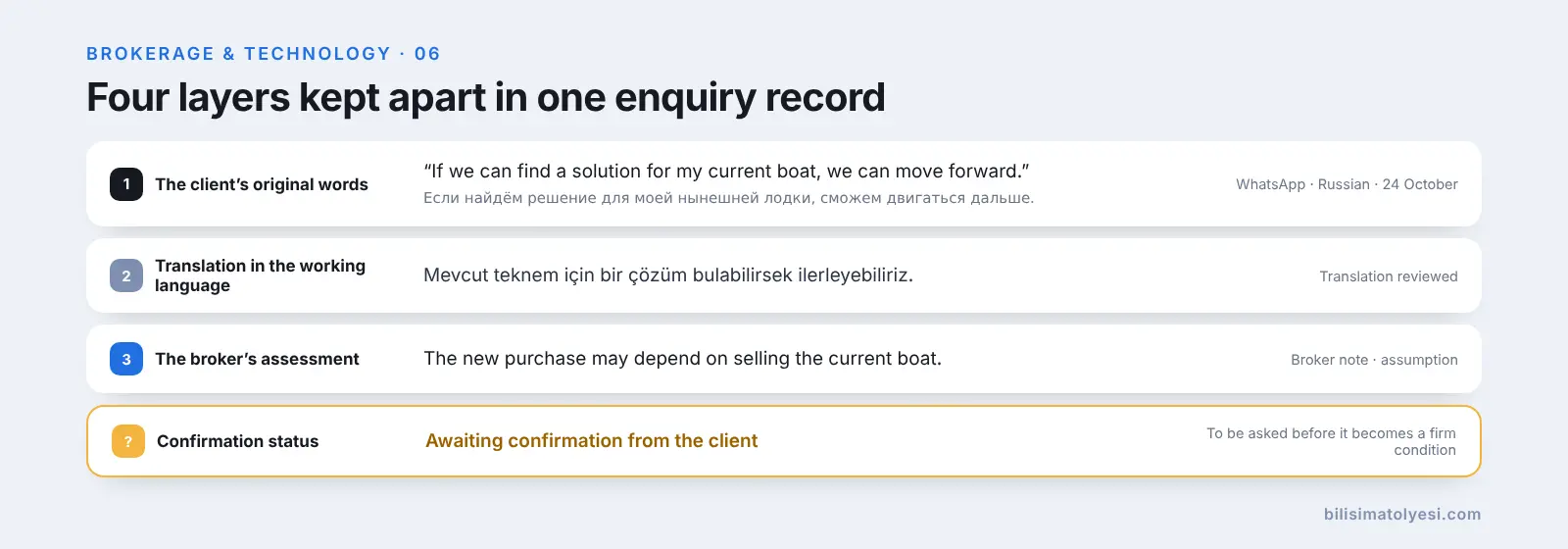
For example, the client says “if we can find a solution for my current boat, we can move forward.” In translation this phrase may stay open. The broker’s assessment might be “the new purchase may depend on selling the current boat.” Until the client confirms it, this assessment should not turn into a firm purchase condition or an accepted trade-in offer.
The record can show the source channel, date, language and whether the translation has been reviewed. In a critical correction, the previous wording is not deleted without explanation. The new information and its source of confirmation are linked to it. That way a short summary written in the company’s working language does not become the only basis for what the client actually said.
Which questions unpack a “ready for summer” request?
A single phrase carries three separate uncertainties. Clarifying them in the conversation prevents sending the wrong options and creating different expectations about the scope of an offer.
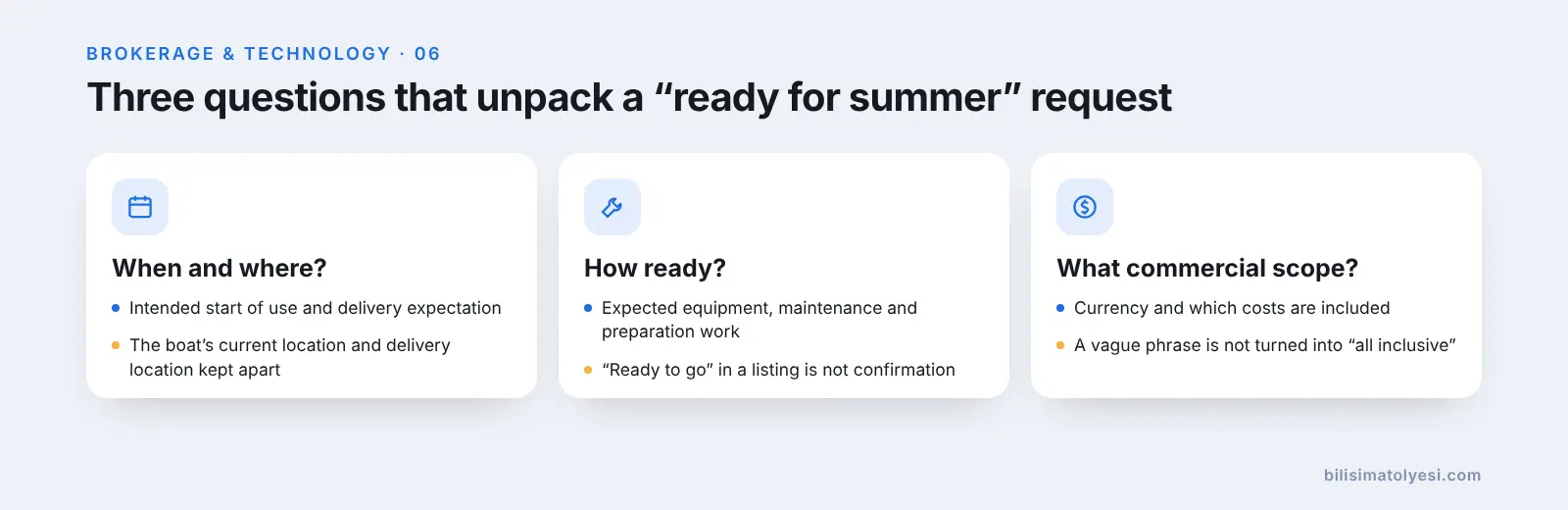
- When and where? “Summer” is neither a calendar date nor a delivery location. The client’s intended start of use, delivery expectation and flexibility are clarified in the conversation. The boat’s current location and the place it is expected to be on delivery are kept apart.
- How ready? The scope of the expectation of being ready to use is asked about. The equipment, maintenance or preparation work the client expects is not confused with the boat’s verified current condition. “Refit” or “ready to go” in a listing does not replace these questions.
- What commercial scope? The currency of the figure discussed, which costs it covers and any points awaiting confirmation in price or tax status are recorded. A translation tool should not turn a vague phrase into an “all costs included” condition on its own.
These questions are not meant to put the client through a long interrogation. They reduce the uncertainties that affect how the conversation continues.
Keep the unit and the currency when moving to shared fields
The client may give the length in feet, the broker in metres. A common unit can be used in the interface for comparison, but the original value and unit should be preserved. The same care is needed for the budget. An indicator converted into another currency does not mean the client committed to a budget in that currency.
If a converted amount is shown, the exchange rate and date used should be clear, and the amount the client stated should remain separate. Terms such as “net”, “gross”, “delivery” and “maintenance included” should also be explained without losing their context. In a CRM, keeping an unknown scope empty or marked as awaiting confirmation is more useful than filling it in as if it were certain.
Boat names, model codes and technical equipment names need consistent terminology. Google Cloud Translation’s documentation gives glossaries as an example for translating domain terms and proper names consistently. In brokerage, such a glossary can support equivalents approved by the team. It does not, however, confirm a client’s commercial intent or an unclear condition by itself.
The original wording is preserved. Translation, the broker’s assessment and the confirmed request are kept apart.
The broker who speaks the language is not always the right match alone
A team member who can communicate in Russian does not have to manage every Russian enquiry alone. The relevant boat segment, the existing client relationship, open file responsibility, availability and follow-up capacity can also be part of the routing decision.
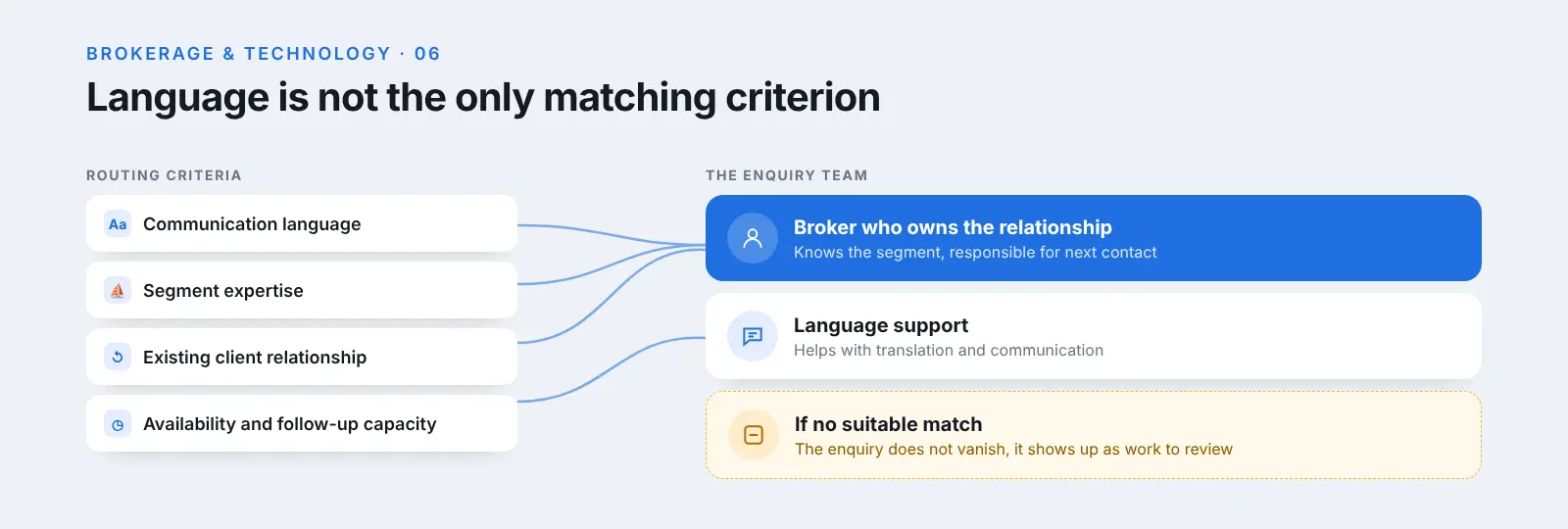
Microsoft’s Dynamics 365 Sales documentation explains how seller attributes such as language, as well as capacity and availability, are used in assignment rules. The approach we recommend for brokerage is to weigh these criteria together with the company’s structure of expertise and responsibility.
If needed, the broker who knows the segment runs the client relationship while another team member provides language support. Who owns the relationship, who helps with translation or technical explanation and who is responsible for the next contact should all be clear. When no suitable match can be found, the enquiry should not quietly disappear but show up as work to be reviewed.
Language is one of the matching criteria. It is weighed together with expertise, the existing relationship and follow-up capacity.
An Arabic enquiry is more than translated text
Multilingual use also shows up on screen. A right-to-left message in Arabic may contain a model name, price, phone number and unit of measurement in Latin characters. Presenting the original text and these values legibly matters so that the record can be reviewed later.
The language a client wrote in and the language they want to continue the conversation in may not be the same. An assistant may have filled in the first form, and another decision maker may join the conversation. Communication preferences, participants and suitable times should be updated through confirmation rather than assumption.
A reply or a draft translation can be prepared automatically. For wording that affects decisions, such as price, delivery terms and technical scope, a step should be left for team review and client confirmation. Content sent to an external translation service should also be limited to what the work requires, and not every attachment or private message should be sent automatically.
In a good handover the client does not explain the same need twice
Imagine a conversation that starts in Russian, moves to an operations team working in Turkish and then to a broker who communicates in English. The handover record should carry the original enquiry, a usable summary, the confirmed fields, the open questions and the next step together.
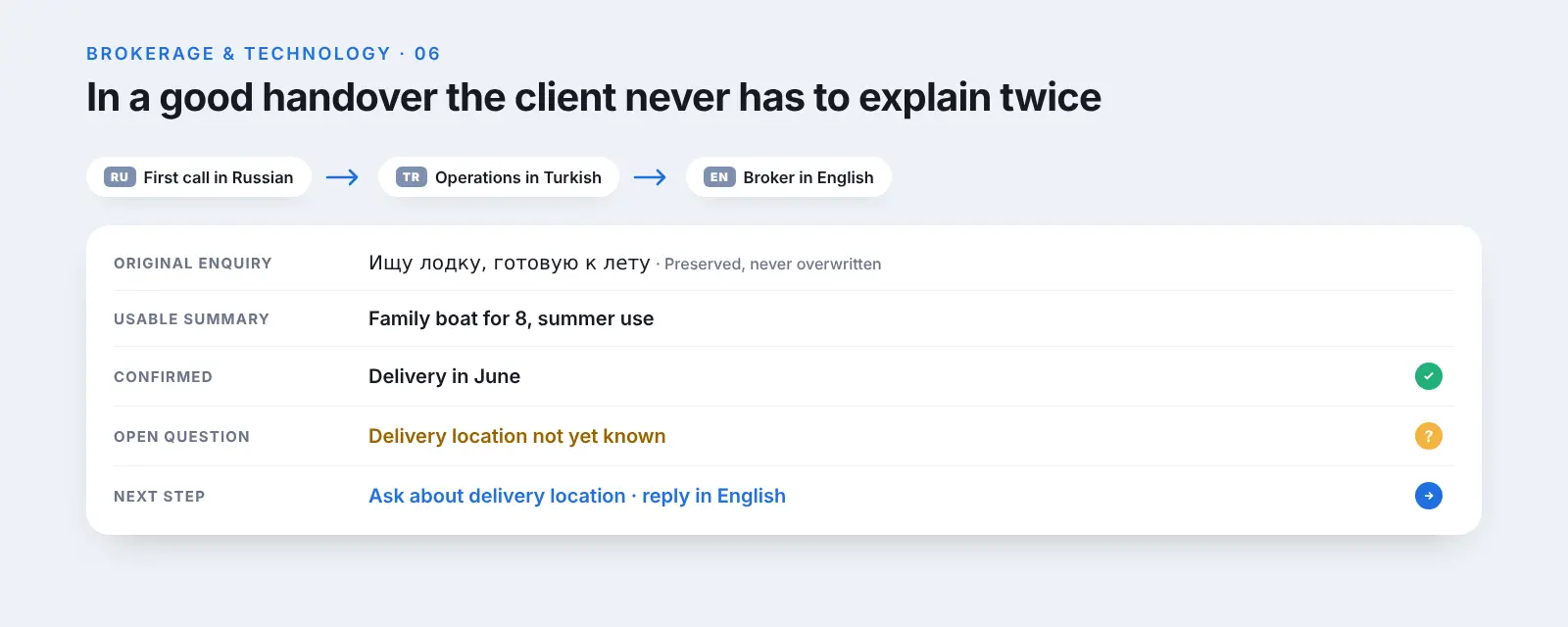
For example, “delivery in June” may be confirmed while the delivery location is still open. The new broker should understand which condition they can continue from, what they need to ask again and in which language to get back to the client. If each person writes their own summary over the previous record, the chain of meaning can break even if the words appear to be preserved.
Multilingual enquiry management with Bilişim Atölyesi
At Bilişim Atölyesi we handle yacht-specific CRM, web forms, listing technologies and API integrations within the same enquiry flow. Depending on the project, multilingual records, shared enquiry fields, broker routing rules and follow-up screens can be designed together.
The right translation starts the conversation. A request that is correctly understood and recorded lets the team carry that conversation forward.
Discuss how enquiries in different languages can reach the right broker in your team.
Previous episode in the series When a Broker Leaves, Does the Client’s History Leave Too? · All articles in Brokerage & Technology