

Not Every Enquiry Is a New Buyer
25 October 2026
Buyers Change. A Yacht’s History Stays With It.
25 October 2026
An enquiry from an Instagram campaign reaches the sales team. The first call goes unanswered. When a conversation eventually takes place, the person explains that they will need to sell their current boat before considering another purchase. The broker makes a note and turns to a discussion that appears closer to a sale.
Months later, a suitable yacht joins the brokerage’s inventory. Can the team retrieve that earlier conversation? Do they know what the person wanted, why they were waiting and what was agreed about further contact? Or will the business pay to introduce itself to the same person all over again?
An enquiry that does not become a sale at the first conversation may still have future value. Equally, a completed form is not a promise of a future buyer. The practical challenge is to distinguish what the business knows, what remains unknown and what should prompt a fresh assessment.
“Not reached” is not a buying decision
An unanswered call tells the team little about purchase intent on its own. An incorrect number, inconvenient timing, an unanswered message and a confirmed lack of interest are different outcomes. Labelling someone “not a buyer” before speaking to them turns uncertainty into a conclusion.
A CRM should distinguish contact outcome, requirement fit and readiness to buy. Having a conversation does not by itself establish a qualified sales opportunity with a suitable budget, intended use and timeframe.
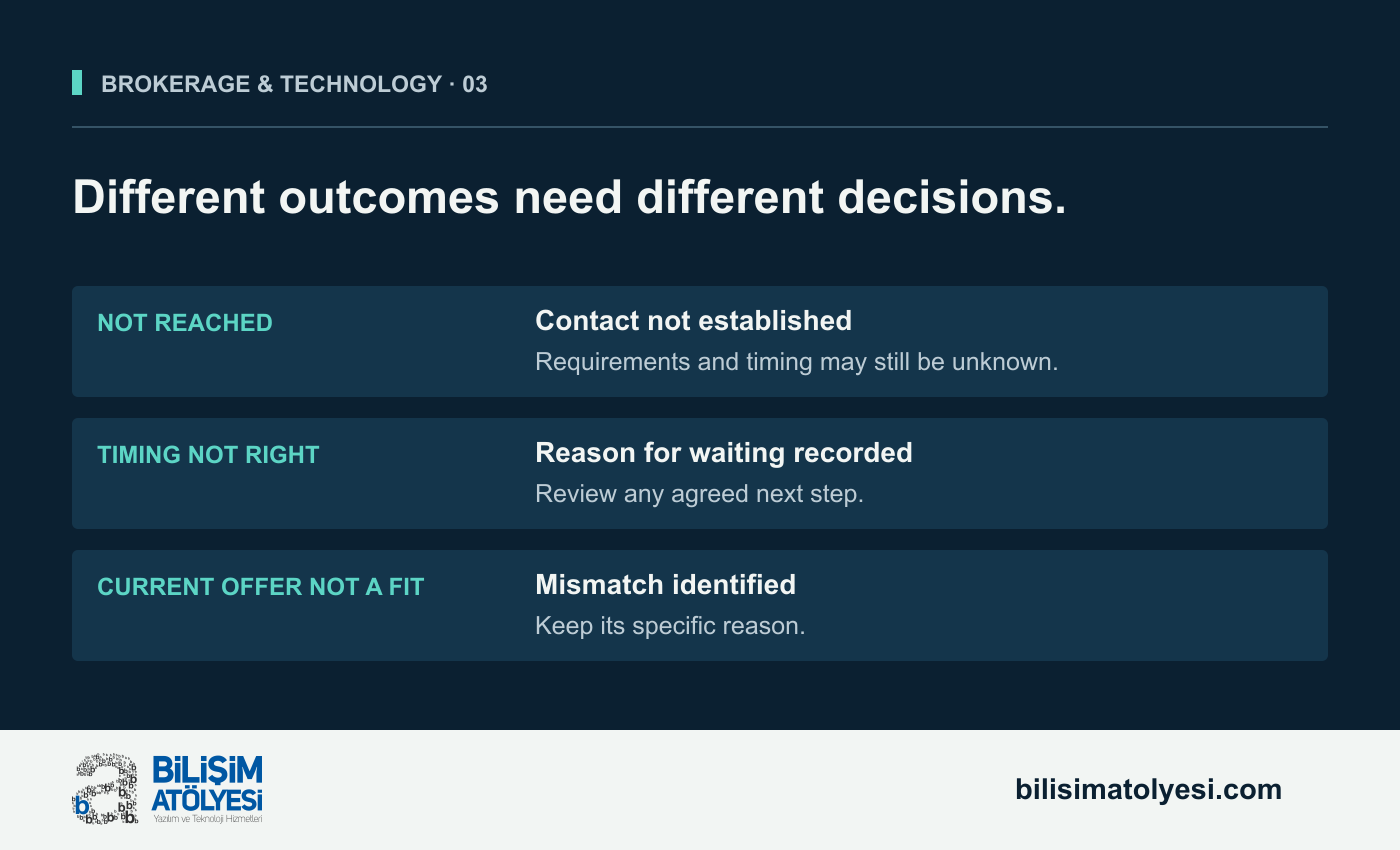
- Not reached: Contact has not yet been established. Details and attempted contact outcomes are recorded; requirements and timing may still be unknown.
- Interested, timing not right: A requirement has been discussed. The reason for waiting and any agreed review date are recorded.
- Not a fit for the current offering: There is an identified mismatch between the enquiry and available options. Its reason is retained separately.
Invalid details, spam and requests for no further contact also need distinct handling. Reporting an unassessed record as a warm lead is no more useful than treating every unknown outcome as a lost sale.
The reason for waiting changes the next conversation
Consider an illustrative buyer researching a yacht for family cruising. Cabin arrangements and berth length matter. A purchase is on hold until their current boat is sold. A note saying “not buying now” omits much of the useful context.
Recording intended use, preferred size range, essential equipment, the status of the current boat and the timeframe actually discussed gives the next conversation a starting point. Budget or purchasing capacity should not be invented where the person has not provided that information.
Requirements change. Record when an important preference was last confirmed and where the information came from. A new discussion should not erase the earlier history. A budget discussed six months ago should not appear as a newly verified budget today.
A segment should support a decision
“Instagram leads” identifies a source. It does not establish a shared requirement. Someone researching a first boat may need different information from an existing owner considering a larger yacht.
Useful segments connect to an action. A newly available yacht can be reviewed against people waiting for alternatives in that size range. Someone waiting to sell their boat may have agreed a date to review their situation. Someone still defining their intended use may benefit from relevant guidance before a detailed proposal.
A segment is a working group that changes as information changes. A click or content opening should not automatically be treated as confirmed purchase intent. Behavioural signals need to be interpreted alongside requirements established through conversation.
There should be a reason to reconnect
Lead nurturing means developing a relationship through relevant information and appropriate contact while someone considers whether and when to buy. Counting messages sent says little about the quality of that work. The broker needs a reason to start a conversation that makes sense for the person receiving it.
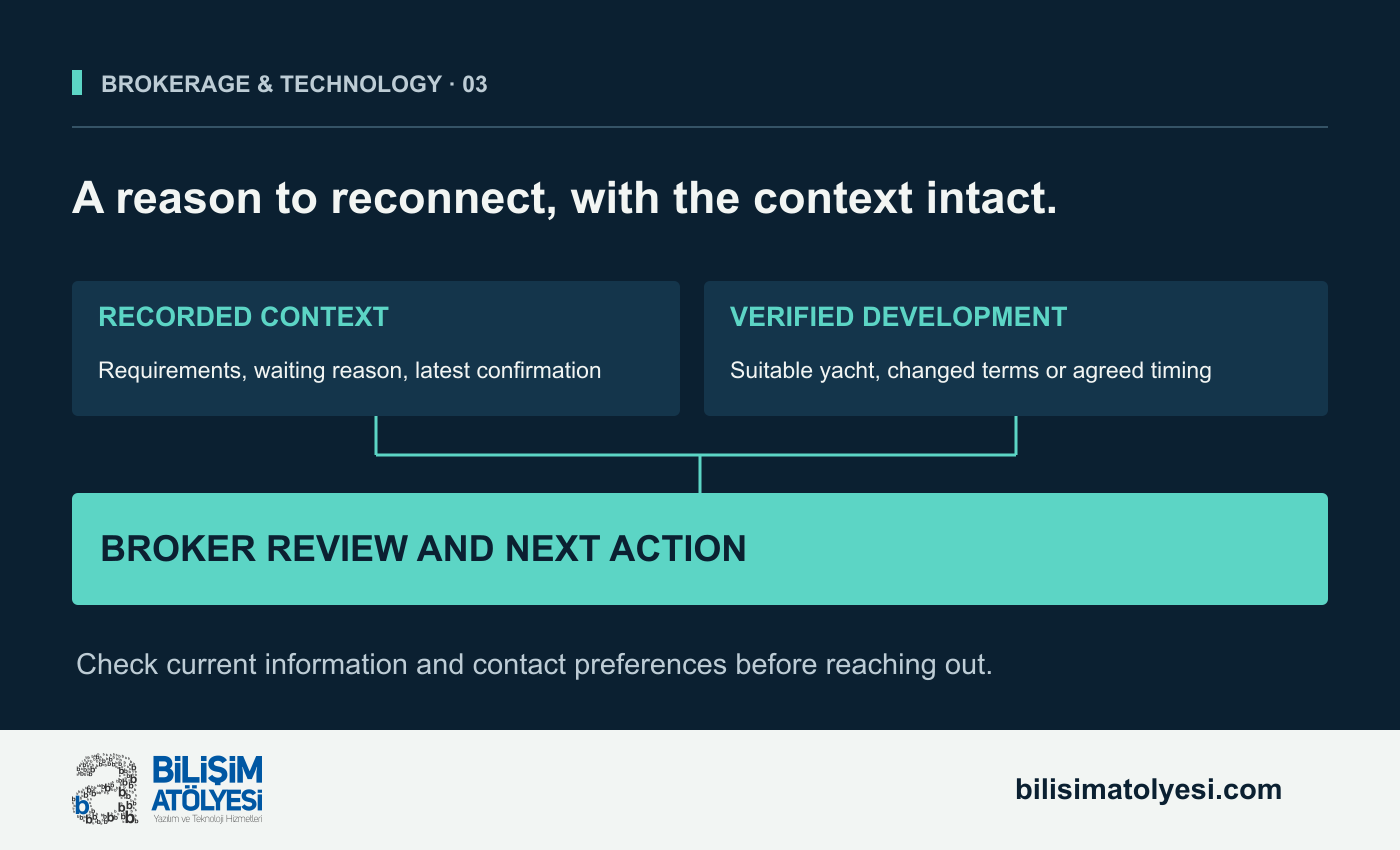
- A yacht matching the intended use previously discussed has become available.
- A verified change affects the price or scope of an option under consideration.
- A relevant viewing or sea-trial opportunity becomes available in the person’s area.
- The team can answer an outstanding question or review the search at the time previously agreed.
A potential match can create a review task for the broker. Before sending a message, the team checks availability, the accuracy of the new information and contact preferences. Automation should surface the context for that decision. An old form submission should not be treated as indefinite permission for repeated messaging.
The relationship history should stay with the business
When a broker leaves or hands a conversation to a colleague, asking the person to repeat their entire story can weaken continuity. The CRM should bring together the enquiry source, requirements discussed, reason for waiting, latest contact, responsible broker and next agreed action.
This creates a useful relationship history beyond a list of contact details. When an appropriate yacht becomes available, the team can identify earlier searches worth reviewing. The person receiving the message can see that the previous conversation has been remembered.
The value of this history depends on its currency. Access should reflect the team’s responsibilities. Old details, contact preferences and the need to retain information should be reviewed periodically. A steadily increasing record count does not on its own establish a stronger buyer portfolio.
The campaign’s first week is only one observation point
Cost per lead measures the cost of collecting an enquiry. The business also needs to understand whether contact was established, whether the requirement was a fit and when discussions progressed into a sales process.
Enquiries can be grouped by the period in which they first arrived and followed over time. For example, the business might review contact, qualification, viewings, proposals and completed transactions after 30, 90 and 180 days. These are illustrative reporting windows, not universal yacht-purchase timelines or conversion targets.
Groups with different observation periods are not directly comparable. A week-old cohort has had less time to progress than one followed for six months. Contact rates, qualified-opportunity rates and sales rates also need clearly defined, distinct denominators.
An initial Instagram enquiry, later website activity and a broker conversation can contribute to the same journey. Explain the attribution model rather than automatically assigning the sale entirely to the first or last channel. CRM history helps examine that journey; it does not prove on its own that advertising caused the sale.
Long-term value means being able to pick up the conversation
Someone who is not ready today may buy later, may never buy or may develop a completely different requirement. A CRM contributes by helping the team use previous information in its current context when something relevant changes.
That can reduce repeated fact-finding, make suitable alternatives easier to assess and improve continuity between marketing and sales. Commercial outcomes still depend on data quality, inventory fit, follow-up discipline and the decisions buyers actually make.
At Bilişim Atölyesi, we consider yacht-sector lead capture, CRM integration, segmentation, broker follow-up and reporting as connected parts of an operation. Depending on project requirements, the workflow can be designed to preserve enquiry context from the initial form through subsequent conversations.
Discuss how your team follows up enquiries received through Instagram.
Previous article: Not Every Enquiry Is a New Buyer.
All articles in Brokerage & Technology.
Technical background
HubSpot’s lifecycle-stage and lead-status documentation distinguishes process stages from contact and timing statuses. Meta Blueprint’s CRM integration course explains how CRM data can inform lead-quality assessment. The yacht-brokerage workflow discussed here is our operational proposal developed around these concepts.
The scenario and diagrams are illustrative. They are not actual customer records, implemented product screens or measured conversion results.