

One Yacht, Different Prices, Different Promises
15 October 2026
They Are Not Ready to Buy a Yacht Today. What Happens Next?
25 October 2026
A buyer first enquires through a listing portal. A few days later, they complete a form for another yacht on your website. They then speak to a member of your team at a boat show. If the CRM creates three people, three broker assignments and three opportunities, the team may start treating a single buying brief as unrelated conversations.
The opposite mistake is just as possible. A matching email address causes the second enquiry to be treated as a duplicate and disappear from view. Yet the buyer may be considering another yacht or adding an important condition to their existing search.
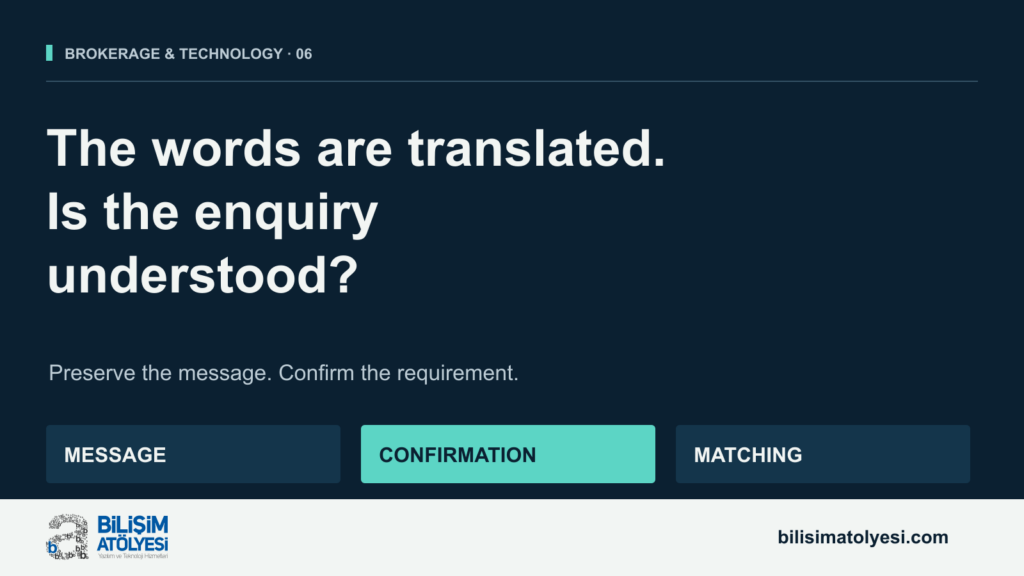
Identifying a person, interpreting a new enquiry and defining a sales opportunity are different tasks. A brokerage CRM becomes useful when it preserves those distinctions and helps the conversation continue with its context intact.
Start by separating three records
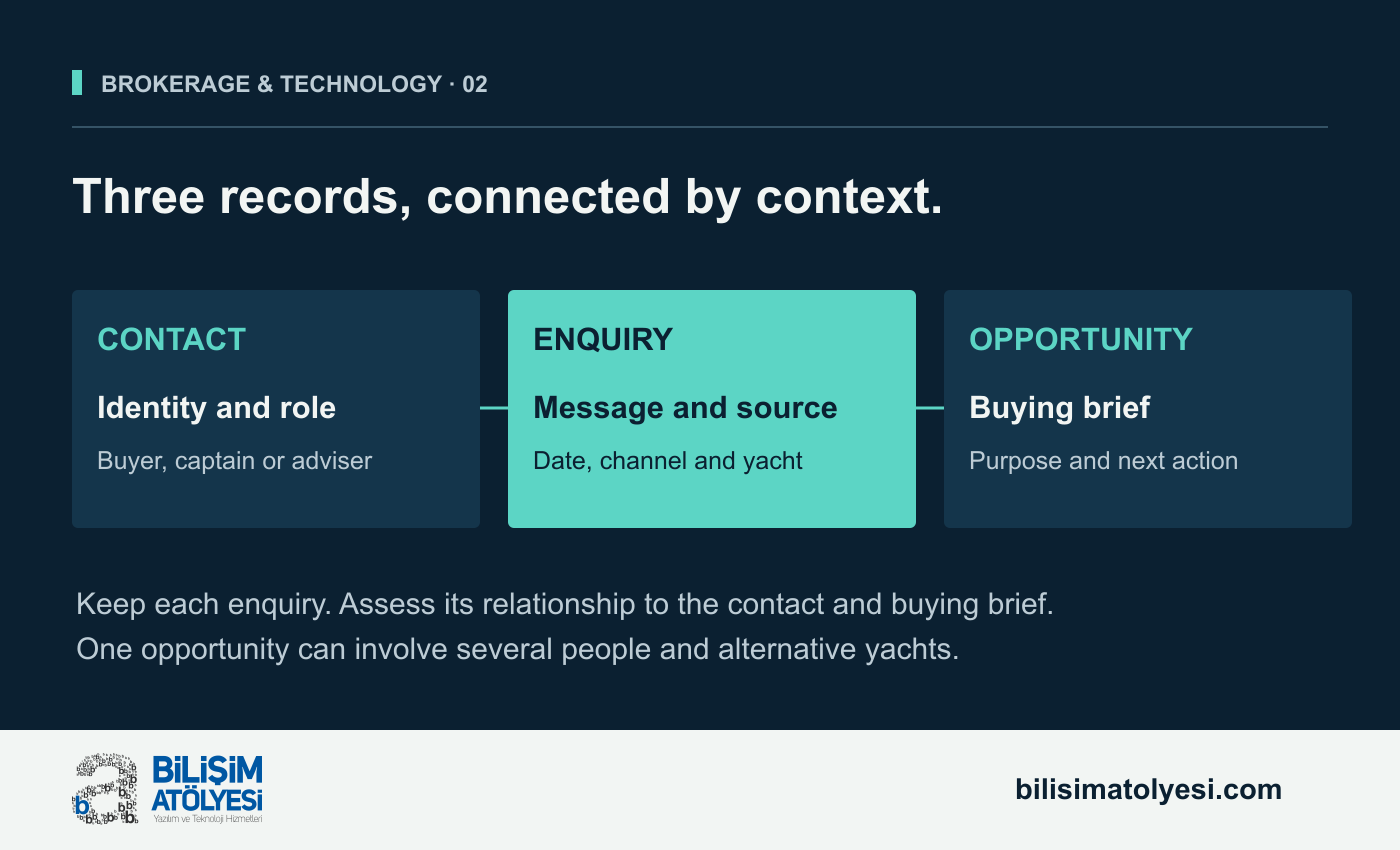
In this article, a contact is the individual involved, an enquiry is an approach received at a particular time through a particular channel, and an opportunity represents a buying brief being pursued. Software products may use different names. What matters is that these records are not treated as interchangeable.
- Contact: Verifiable contact details, the person’s role in the process and relevant relationships.
- Enquiry: The original message, timestamp, channel, yacht or listing reference and source.
- Opportunity: Buying purpose, alternatives under consideration, current stage, follow-up responsibility and agreed next action.
One person can make several enquiries and compare several yachts within the same buying brief. An opportunity may involve a buyer, captain or adviser. Squeezing all of these relationships into one customer-notes field makes them harder to retrieve and interpret later.
Three yachts do not necessarily mean three purchase decisions
Consider an illustrative scenario. A buyer is comparing three similarly sized yachts for family use. The budget range, intended use and purchase timing are the same. Opening a separate opportunity for each yacht could count one buying brief several times in a sales forecast.
Depending on the brokerage’s opportunity definition, those yachts can be alternatives within the same search. Questions, viewings and proposals remain traceable to each yacht, while the buyer’s decision context stays connected. A longer shortlist does not automatically create more opportunities.
The same person could also be researching a yacht for personal use and another for a separate business requirement. Those may warrant distinct opportunities. A new search beginning a year later should not overwrite the earlier one. The relevant distinction is the buying purpose, not simply the contact or yacht.
A phone number is not the whole identity
Names, email addresses and phone numbers can help identify potential matches. A similarity is not always conclusive evidence of identity. A shared office address, an assistant acting for several people or a differently written name can require review.
In brokerage, the person completing a form is not always the eventual buyer. Record whether a captain, adviser or cooperating broker is approaching the firm on someone else’s behalf. Two people associated with one opportunity do not need to become one contact record.
Finding a possible match and merging records should therefore be separate steps. Uncertain cases need review. An approved merge should leave sources, relationships and the action itself traceable. An automated response must not disclose another customer’s history to someone whose identity remains unclear.
A retried integration event is different from a new message
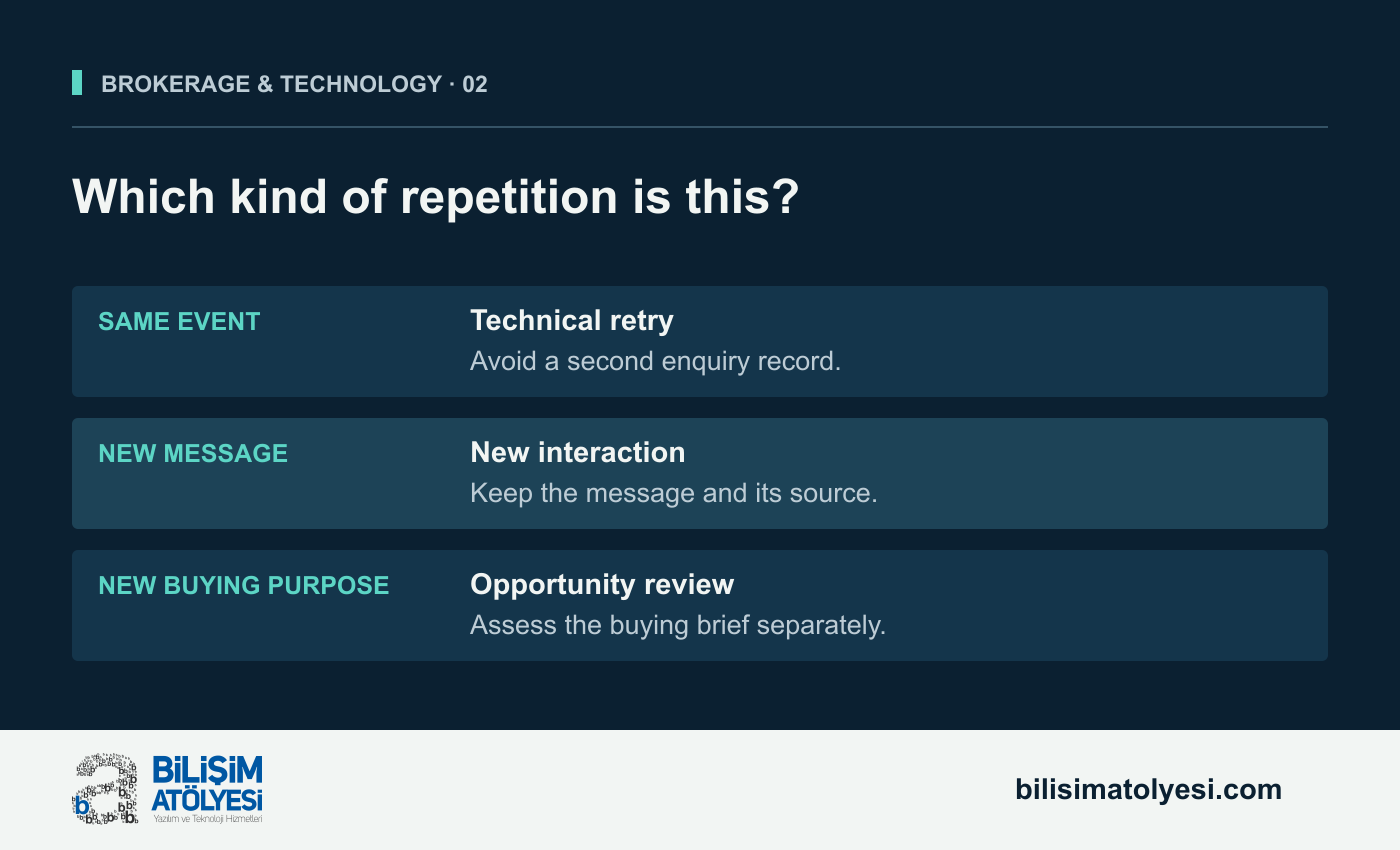
A portal or form integration may resend an event when it does not receive a response. Treating that technical retry as a new enquiry creates unnecessary work. A buyer asking a different question the following day is a new interaction.
Where the integration supports it, use the source event identifier and a processing record to distinguish a retry from a new submission. Reprocessing the same event should not create a second business record, while a genuinely new message retains its own time and content.
Associating an enquiry with an existing person does not mean deleting the enquiry. The new message can add to an existing conversation or be assessed as part of a separate buying brief, with its provenance intact.
A new source should not erase an earlier one
Where a person first encountered the business, where their latest enquiry originated and how a particular opportunity began are different questions. A new website form should not make an earlier portal enquiry or boat-show conversation disappear.
Each enquiry can retain its source, date and listing reference. Separating first contact, latest interaction and opportunity origin makes the purpose of each report clearer.
A message received after a campaign is not necessarily a newly acquired buyer created entirely by that campaign. Equally, considering only the first contact can overlook later contributions. Define the attribution model before drawing conclusions from a single source field.
Broker assignment is responsibility for follow-up
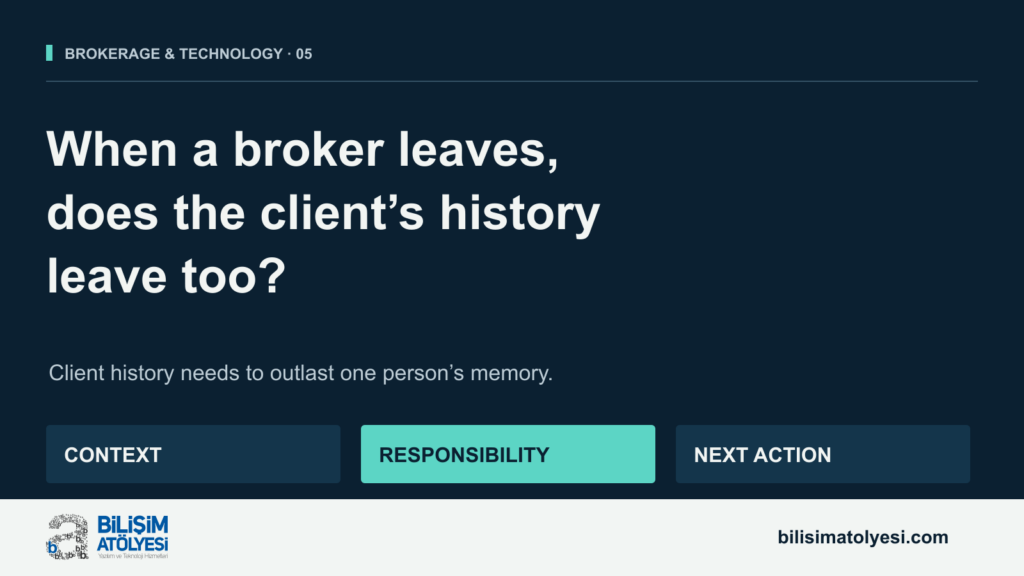
When someone with an existing conversation enquires again, the system should make that context available before assignment. The active opportunity, current broker and outstanding next action should be visible to the relevant team.
This does not mean attaching a person to one broker indefinitely. The buyer’s preference, brand or regional responsibilities, representation arrangements and team structure all matter. If a handover is needed, record its reason and the person taking over.
Cooperation and commercial arrangements between independent firms remain separate decisions. A CRM ownership field does not establish those relationships. Coordinate the work while limiting customer-data access by role and responsibility.
What should a broker understand when opening the record?
- Who is involved? The buyer, or someone communicating on their behalf?
- What does this enquiry change? Another alternative, a revised budget or timing requirement, or a separate buying purpose?
- What has already been discussed? Which yachts were ruled out, and which viewing or proposal was agreed?
- What is outstanding? Information, a viewing, a proposal revision or the buyer’s response?
- Who acts next, and when? Is responsibility and an agreed follow-up time clear?
Attach each status to the right subject. Ruling out one yacht does not close the buyer’s whole search. Putting a buying brief on hold does not mean the contact will never consider another proposal.
Which activity does the reported number count?
Enquiries received, verified unique contacts and qualified opportunities are different measures. First-time and returning enquiries, interest in individual yachts and buying processes that are progressing should not be treated as one interchangeable total.
Merged records, missing source data and opportunity-creation rules all affect the report. Agree on the definitions before judging performance. More forms alone do not establish more buyers or a stronger forecast.
At Bilişim Atölyesi, we design yacht-sector CRM systems, lead capture, listing technologies and API integrations around the broker’s working day. Depending on the project, contact matching, enquiry history, opportunity relationships and follow-up responsibility can be considered within the same workflow.
Discuss how incoming enquiries are handled by your team.
Previous article: One Yacht, Different Prices, Different Promises.
All articles in Brokerage & Technology.
Technical background
HubSpot’s record-association documentation describes relationships between CRM records. Salesforce’s standard duplicate-rule documentation explains the role of matching rules in duplicate detection. The yacht-brokerage workflow in this article is our operational design proposal built around those distinctions.
The scenario and diagrams are illustrative. They are not actual customer records, screenshots of an implemented automation or measured commercial results.