


Buyers Change. A Yacht’s History Stays With It.
25 October 2026
Is Translating the Client’s Words Enough to Understand the Enquiry?
25 October 2026
The client’s number is in the CRM. So is the yacht they enquired about. But only one broker knows why they have not made an offer: a purchase depends on selling their current vessel, a detail raised during the last viewing remains unresolved, or another person needs to join the next discussion.
When that broker takes leave, moves to another assignment or leaves the company, where does the relationship resume? With a telephone number, or with enough understanding to avoid asking the client to start again?
A company’s client history should extend beyond what one broker can remember at the next meeting. Relevant knowledge gathered while representing the business needs a usable place in its records, with a source, a date and appropriate access.
What is the private notebook doing that the CRM is not?
Personal notes are not inherently a problem. Draft thoughts, daily plans and meeting preparation can remain part of a broker’s working method. The problem begins when the only current information that changes the service the client receives exists in that notebook.
It is easy to assume that the broker simply wants to keep information private. First, examine the system and the working arrangements. If recording a conversation takes too long, earlier notes are hard to find, or the CRM appears to exist mainly for management reporting, a broker may return to a tool that helps them get the work done.
There can also be concern about losing the relationship. Someone who expects that sharing information will blur client responsibility or make their contribution invisible may enter only the minimum. Clear responsibilities and recognition of contributions matter alongside usable screens.
How do you prepare for a meeting from the word “interested”?
Consider an illustrative conversation. A buyer is looking for a 24–28 metre motor yacht. At first, this looks like an active enquiry. Further discussion establishes that the purchase depends on selling their current vessel, that the separation of crew and family spaces matters, and that the next conversation should follow an update on the existing sale.
If the CRM says only “interested in a 28 metre motor yacht”, another broker may send unsuitable options or push for an offer before a meaningful next step is possible. Recording the client’s stated condition, reasons for excluding particular yachts and the purpose of the next contact allows a better-informed conversation.
The useful record contains confirmed search criteria, the condition affecting the purchase, the decision process described by the client and the agreed next action. An observation such as “cannot afford it” is not the client’s statement and should not be recorded as an established fact.
Turn a conversation into a record someone can use
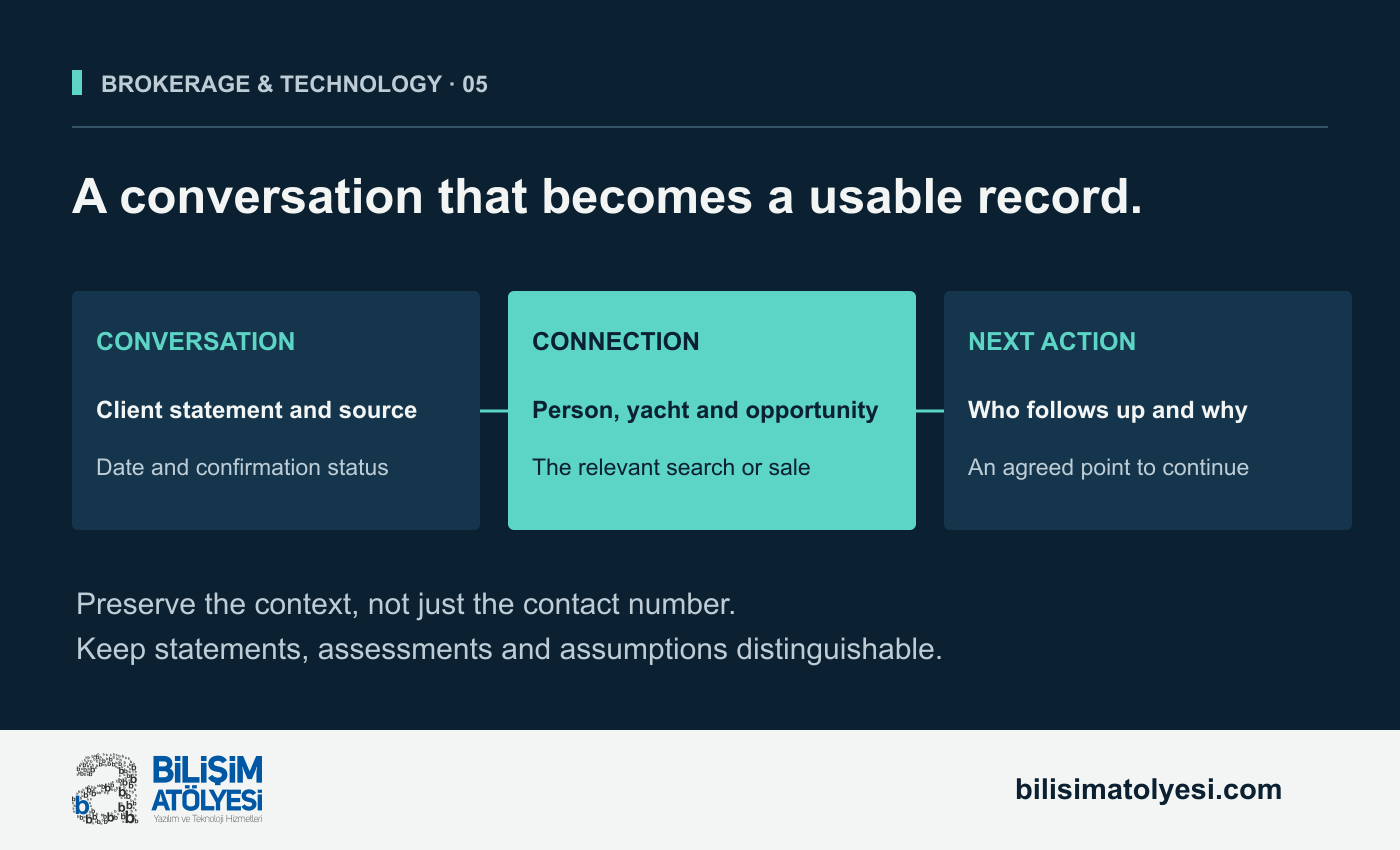
This does not require a transcript of every call. Short, connected records can provide a practical basis for the next discussion:
- What was learned and what supports it. What did the client say, when and in which conversation? Distinguish a confirmed statement from the broker’s assessment and an assumption that still needs checking.
- The relevant person, yacht and opportunity. Show which search or sale process the information concerns. A new enquiry should not silently overwrite the conditions of an earlier one.
- The next action and responsible person. Who will follow up, on what, when and for what reason? A task needs a purpose as well as a due date.
Bringing calls, emails, meetings and tasks together around a customer record is an established CRM pattern. For example, Microsoft’s Dynamics 365 Sales documentation describes viewing these activities in a record’s timeline. In brokerage, the design work is to connect that history meaningfully with vessels, buying briefs and sales opportunities.
Client responsibility and access to information are separate decisions
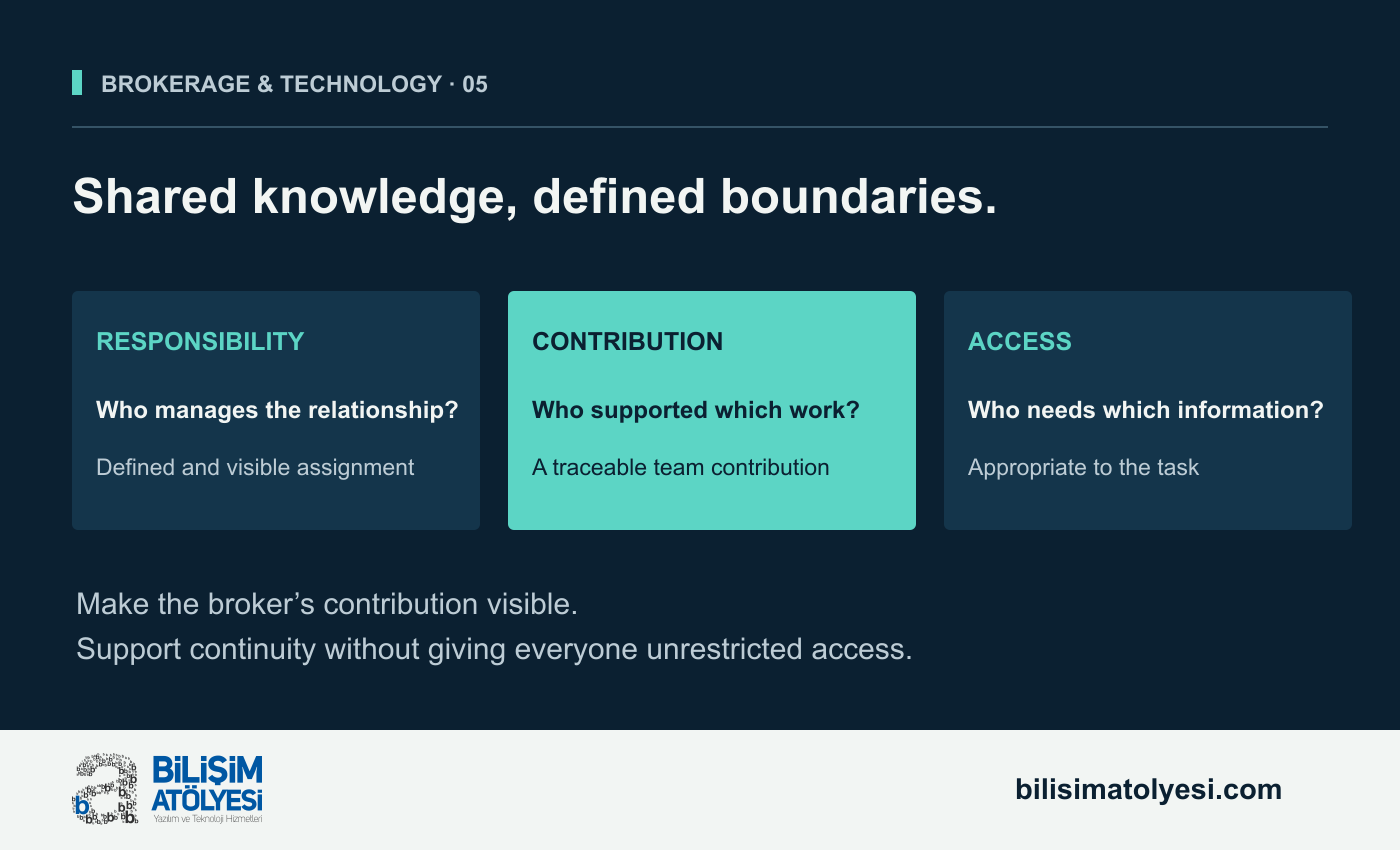
Building shared company knowledge does not mean giving every broker unrestricted access to every client note. The broker managing the relationship, a colleague providing temporary cover and an operations manager may need different information.
The person responsible for the client, contributing team members and people allowed to view the record should be defined separately. A broker may attend a viewing and add an assessment without taking over the client relationship. Temporary access during a colleague’s leave should not be confused with a permanent reassignment.
Dynamics 365’s opportunity team model provides an example of associating members with defined roles and granting access to a particular opportunity. Our proposed brokerage model likewise treats responsibility, contribution and access as separate design decisions.
A system that records contributions, makes responsibility changes visible and explains sharing boundaries can address the practical question, “Will entering this information cost me the relationship?” Commission arrangements and allocation of work still require clear company rules. A CRM does not establish those rules by itself.
A handover needs more than a list of contacts
Reassigning names and telephone numbers is the straightforward part of a handover. The next broker also needs to understand open opportunities, commitments made to the client, outstanding documents, yachts already considered and rejected, and the reason for the next contact.
They should be able to distinguish current information from conditions that need to be checked again. A budget or time frame mentioned two months ago may have changed. The earlier note retains its date, while a new confirmation is recorded separately. History should not present itself as the current position.
A handover workflow can support the review of open tasks, assignment of a new responsible person and updates to the former user’s access in line with the company’s process. How the relationship continues, including how the new contact is introduced to the client, is part of the operation too.
Not everything heard belongs in the client record
The depth of a client history is not measured by how many details have been collected about a person. Unrelated private information, rumours and personality labels do not become useful sales records simply because someone enters them in a system. Necessary information should be considered together with its purpose and who needs access to it.
The client’s own statement and the team’s commercial assessment should be distinguishable. “Requested delivery next season” and “an indecisive client” are different types of note. The first communicates a time frame that can be checked. The second can bias a future discussion when its context has disappeared.
A recording standard should therefore cover source, date, currency and a process for correction or removal when appropriate. Company knowledge should not be designed as an unlimited archive of the client’s private life.
Daily usefulness makes the second notebook less necessary
A good CRM should not aim to ban personal notes. It should provide a dependable current record for the work the company needs to continue. When a broker can capture a short update after a conversation, retrieve earlier discussions quickly and see the next meaningful action, the system becomes part of doing the job.
Counting completed fields alone misses that purpose. How many open opportunities have a responsible person and a clear next action? How many questions must be asked again after a handover? Can the team distinguish outdated conditions from current ones? These are useful ways to assess whether records support the work, rather than promises of a particular result.
At Bilişim Atölyesi, we approach yacht brokerage CRM alongside customer and vessel records, listing technologies, API integrations and sales operations. Conversation history, task management, permissions and responsibility handovers can be designed as parts of the same workflow, according to how the business operates.
The broker’s contribution should remain visible while the company can continue serving the client. Reducing reliance on a separate private notebook means designing for both needs.
Discuss how client history can support your brokerage team’s workflow.
Previous article: Buyers Change. A Yacht’s History Stays With It.
All articles in Brokerage & Technology.