



Why every company needs an MCP strategy
29 October 2026
This time in Tech Notes we’re not covering news from around the world; we’re explaining the technical side of a system we built ourselves. Our topic is how the data that already exists on a boat leaves the boat and reaches a mobile app. We built this infrastructure, with our own hardware and software, under the name Boat Metric.
The common language on board is NMEA 2000
On a boat, the engines, battery monitor, tank sensors, GPS, compass, depth and wind sensors and the displays at the helm are usually connected to a single network. Its standard is NMEA 2000. It is based on the CAN bus familiar from the automotive world and the SAE J1939 protocol, and it runs at 250 kilobits per second. In the previous generation, NMEA 0183, only one device could talk on a line and speed was limited to 4,800 bits per second. On NMEA 2000, every device on the network can both transmit and listen.
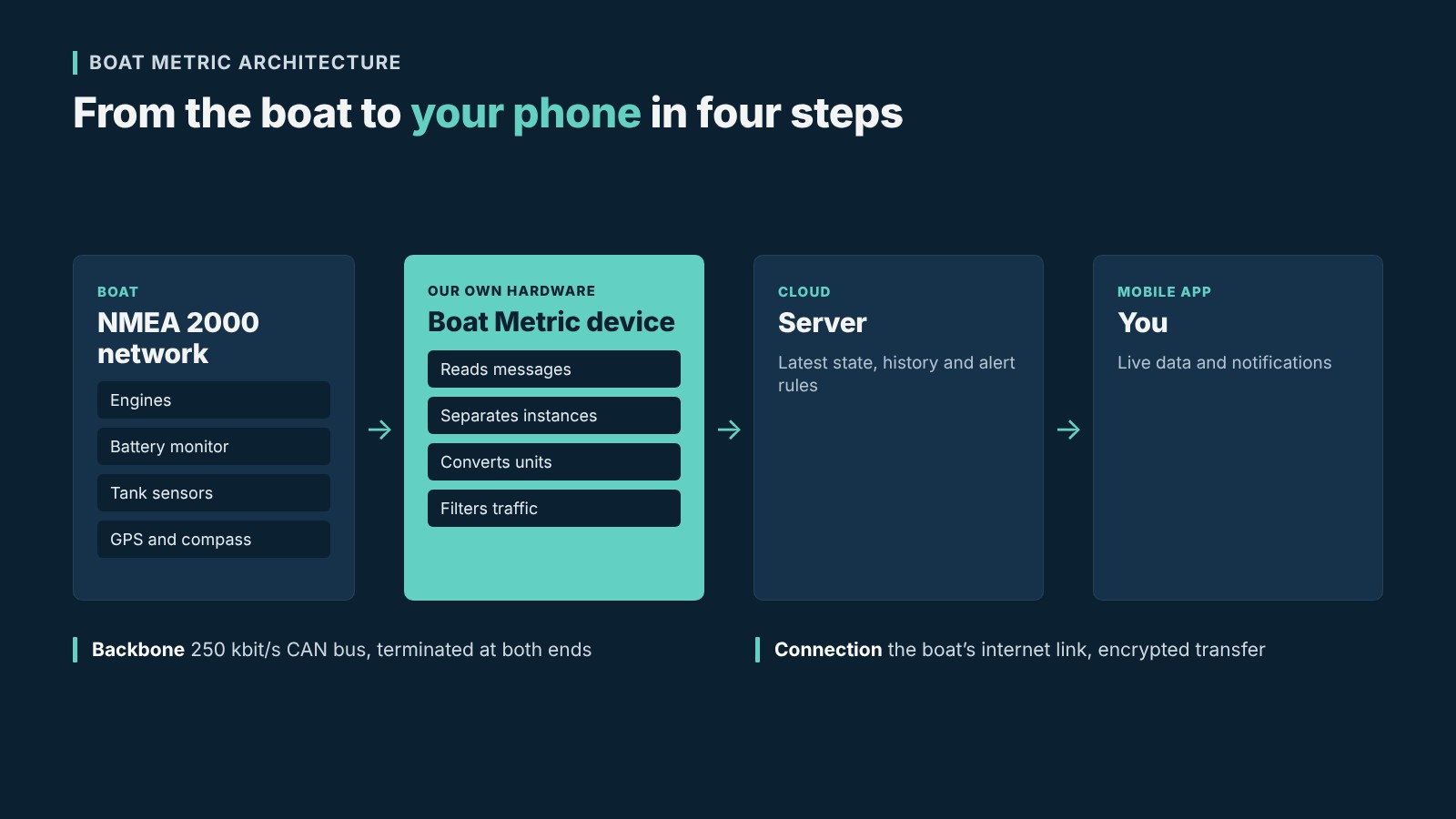
The physical layout is simple. A backbone cable runs from one end of the boat to the other, closed at both ends with terminating resistors. Devices connect to the backbone with drop cables of up to six metres. Depending on the cable type, the backbone can be 100 to 250 metres long.
Every message has a number
Every message on an NMEA 2000 network is identified by a PGN (Parameter Group Number). The receiving device looks at the PGN to know how to interpret the bytes in the message. Some of the data Boat Metric reads comes from these messages:
| PGN | Message | What you see in the app |
|---|---|---|
| 127488 | Engine Parameters, Rapid Update | Engine RPM, engine trim angle |
| 127489 | Engine Parameters, Dynamic | Coolant temperature, oil pressure, engine hours, alternator voltage |
| 127505 | Fluid Level | Fuel, fresh water and waste water tank levels |
| 127508 | Battery Status | Battery voltage and current |
| 129025 / 129029 | Position, Rapid Update / GNSS Position Data | The boat’s position |
| 127250 | Vessel Heading | The boat’s heading |
| 127257 | Attitude | Roll and pitch |
| 128267 | Water Depth | Depth |
Which messages are on the network depends on the boat’s equipment. If a boat has no tank sensor, no tank level is published. That’s why before every installation we listen to the network and map which device publishes which data.
Reading the data isn’t enough; it has to be processed
The raw messages coming off the network aren’t ready to show in an app. The Boat Metric hardware does the work in between, and that work has a few important steps.
Telling devices apart. On a twin-engine boat, both engines transmit with the same PGN; the “instance” number tells them apart. The same applies to multiple batteries or tanks. The device matches every value to the right engine, battery and tank.
Reassembling split messages. A CAN frame carries at most eight bytes of data. Longer messages are split across several frames using the “fast packet” method and have to be reassembled on the other side.
Converting units. The standard carries temperature and pressure in units such as Kelvin and Pascal. To show users the Celsius and bar values they’re used to, the conversion happens on the device.
Filtering unnecessary traffic. Some messages, such as engine RPM and position, are published ten times a second. Sending all of them to the cloud would waste both bandwidth and money. The device sends meaningful changes and summaries, and samples more often when needed.
From the cloud to a notification
The processed data reaches the server, encrypted, over the boat’s internet connection. The server keeps the latest state of each boat and the mobile app shows that state live. The alert rules run in this layer too.
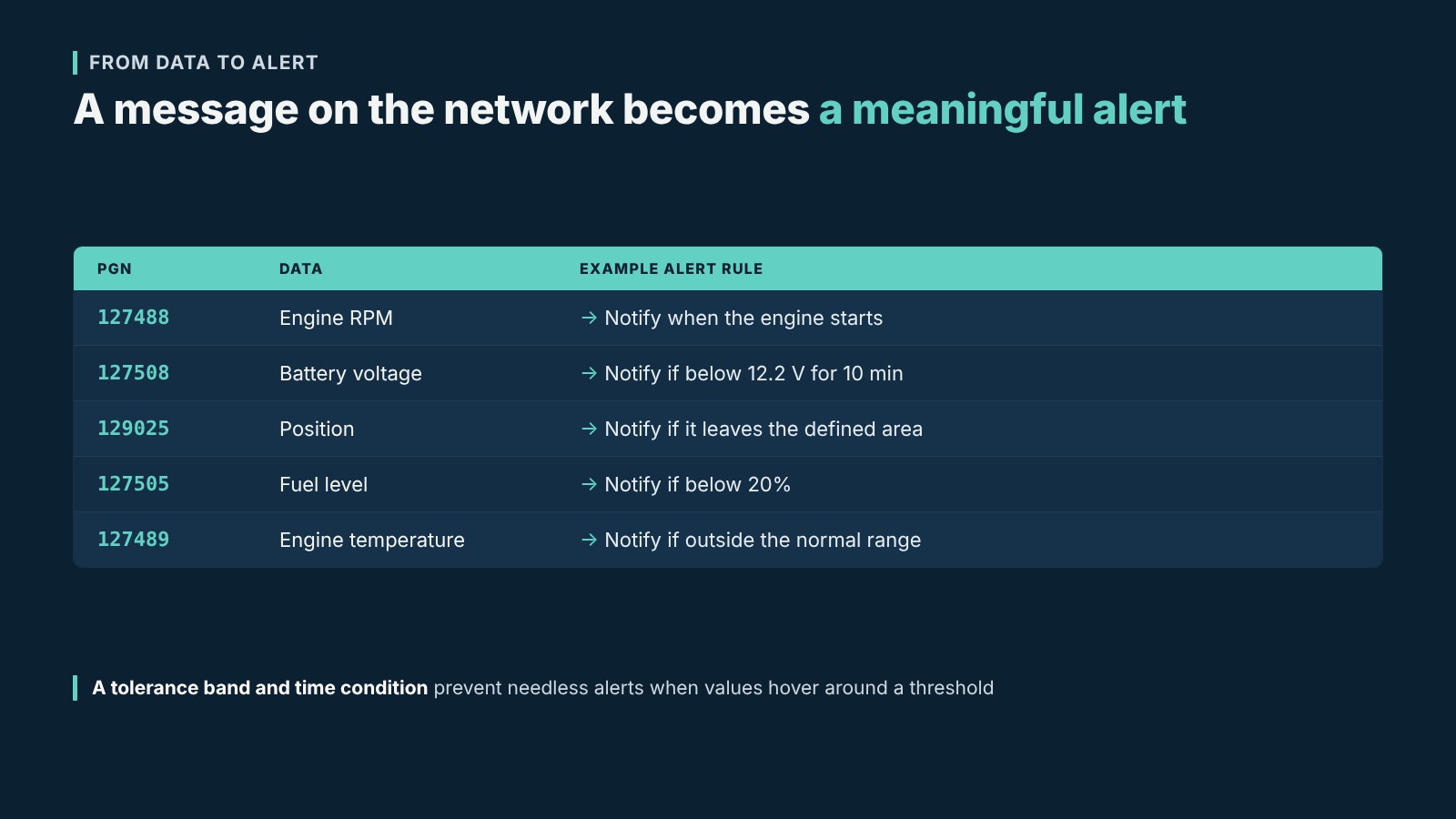
The trick to a good alert system is avoiding unnecessary notifications. If battery voltage hovers right around the threshold and every crossing triggers an alert, users soon switch notifications off. So we define a tolerance band and a time condition around each threshold; an alert goes out only if the value stays outside the limit for a set period. For geofence alerts we also leave a margin that accounts for the natural drift of GPS.
Our take
An enormous amount of data flows around a boat, yet only a tiny part of it ever reaches the owner. That’s why remote monitoring isn’t a luxury; it’s the cheapest way to protect a boat’s health. A battery problem or a rising engine temperature caught in time can prevent a breakdown in the middle of the season.
The industry’s next step is already in sight. NMEA is working on OneNet, a new Ethernet-based standard, which means the volume and variety of data on board will grow. Owners, businesses and service teams who start collecting their data in an organised way today will be far better prepared for that change.
For details on Boat Metric, see our product page, read the blog article written from the owner’s point of view, or write to us.