


Why Sailing Clubs Can No Longer Put Off Their Digital Transformation
17 November 2026
In a brokerage, the day often starts with the same question. Which yacht should be presented to this client today, with what information, and by whom?
The answer usually sits in several places at once. The enquiry is in an Instagram message, the budget is in a broker’s phone notes, a suitable yacht is on another company’s listing page and the last price discussed is somewhere in a WhatsApp thread. Each piece is useful on its own. When they are not connected, however, brokers spend a large part of their time gathering information rather than selling.
Earlier parts of this series looked separately at enquiry history, vessel records, broker handovers and multilingual enquiries. This part steps back to look at the whole picture. We go through the systems that make up a yacht brokerage’s digital infrastructure, how they work together, and where AI is genuinely useful within that structure.
The goal is not to use more software. It is to bring client, yacht and sales information together in the same record.
Thinking about the infrastructure in four layers
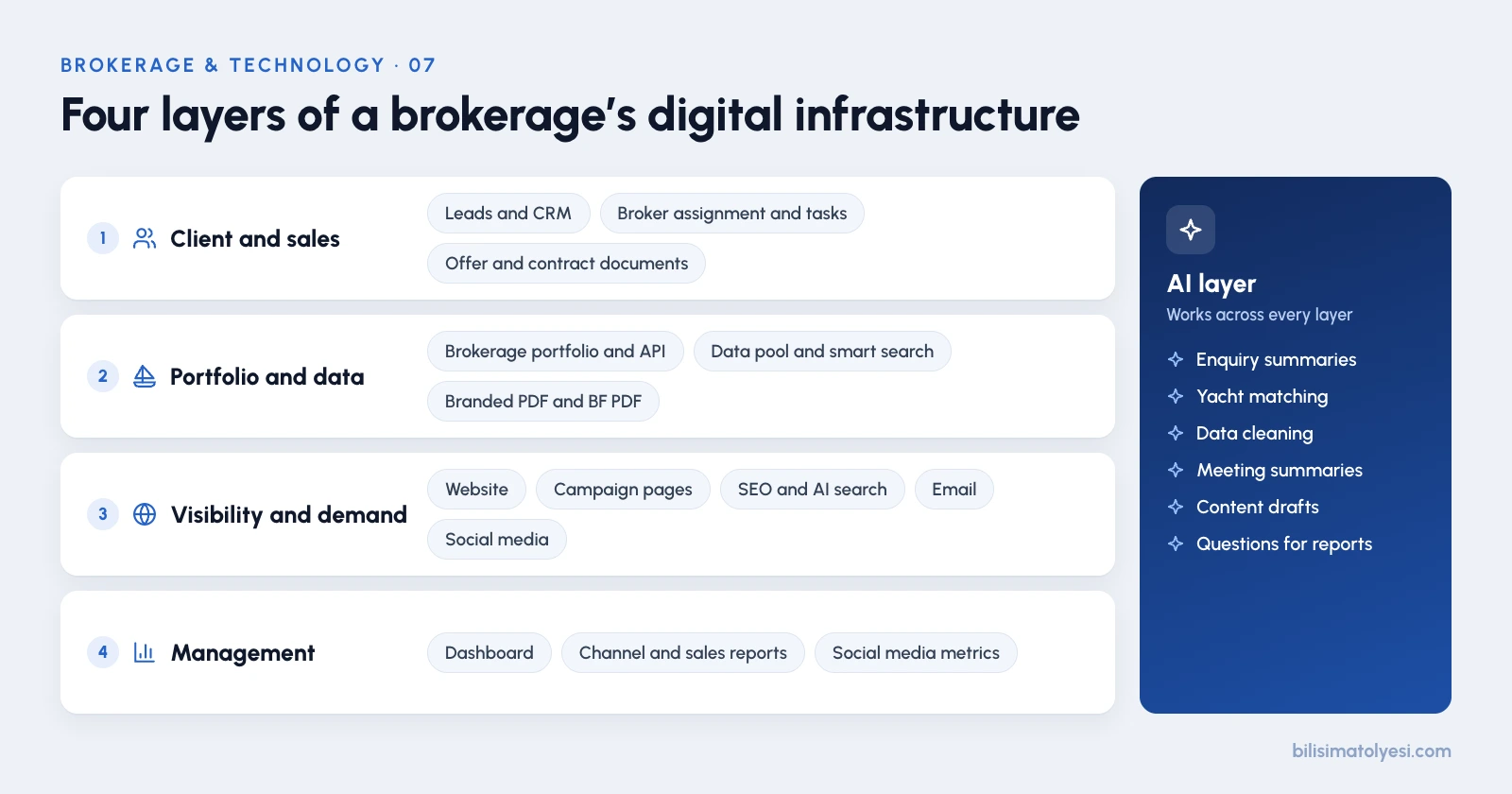
It is easy to list the systems a brokerage needs. To see which part feeds data into which, it is more useful to think of them in layers.
- The client and sales layer holds the CRM, task tracking, and offer and contract documents.
- The portfolio and data layer covers the company’s own yachts, listings from external sources, smart search and PDF generation.
- The visibility and demand layer is made up of the website, campaign pages, SEO, email and social media.
- The management layer is the dashboard and reporting where all of this activity is followed on one screen.
AI is not one of these layers. It is a supporting layer that works across all of them, which is why we cover it separately at the end.
The client and sales layer
1. Lead, CRM and broker management
Every enquiry from the website, campaigns, email, telephone and social media should arrive in one place. When a client’s contact details, the yachts they are interested in, their budget, intended use and conversation history sit in the same record, the broker does not start the next conversation from scratch.
Enquiries should be assignable to the right broker, and meeting notes, tasks, reminders and sales stages should be trackable in the system. Management can see open opportunities, pending work and broker activity. Client follow-up no longer depends on personal notes, and when a broker leaves, the knowledge stays with the company.
2. Offers, contracts and sales documents
As a sale progresses, the same information is typed again and again. The client’s name, the yacht’s specifications, the price and delivery terms are re-entered in every new document. Once the company’s approved offer and contract templates are set up in the system, this information comes directly from the CRM and portfolio records.
Every version of every document is stored in the relevant sales file, so nobody has to search mailboxes to find which offer was sent when and on what terms. Contract wording and commercial terms remain the company’s responsibility. The system simply organises preparation and tracking.
The portfolio and data layer
3. Brokerage portfolio management and API integration
Specifications, prices, images and sales status for every yacht in the company’s brokerage portfolio should be managed in one place. Through an API, this central portfolio can share data with authorised partners, broker platforms and listing sites. The company decides which yachts and which fields are shared.
The same structure works in the other direction. Portfolio data offered via API by external brokers and yacht platforms is mapped to a common record format and brought into the system. The scope of each connection depends on the source’s API access and data usage permissions.
4. Yacht data pool and smart search
The yacht a client is looking for is not always in the company’s own portfolio. Smart search brings the company portfolio and accessible external sources together in a single search. The broker searches by budget, length, model year, brand, model and other requirements, without browsing several platforms one by one and reorganising what they find.
Yachts selected from the results move straight into a client presentation or the PDF preparation step.
5. Branded PDF and broker-friendly PDF
A selected yacht or shortlist becomes a PDF presentation in the company’s corporate identity. Images, specifications, price and the responsible broker’s contact details appear in a standard layout, with no separate design work needed for each presentation.
Sharing between brokers needs a different format. A broker-friendly (BF) PDF is prepared for this purpose, with the information and contact fields it shows defined separately. Because both formats are generated from system data, new PDFs carry current information whenever a price or specification changes.
The visibility and demand layer
6. Corporate website and portfolio infrastructure
The website brings together the brands represented, new models, the brokerage portfolio and services. What matters most for a brokerage, though, is that the site works with the central portfolio and the CRM. An update in the portfolio is reflected on the site, and submissions from contact and yacht enquiry forms go straight into the CRM.
7. Campaign and lead capture pages
Focused pages are prepared for a boat show, a new model launch or a specific yacht. Submissions from these pages reach the CRM together with their campaign source. The sales team knows which event or content brought the client in, and management can see which campaigns actually move closer to a sale.
8. SEO and visibility in AI search
Buyers no longer search only on Google. They also ask answer engines such as ChatGPT, Gemini or Perplexity questions like “40 ft catamaran for sale in Turkey”. Organic visibility work therefore needs to cover both sides. Site structure, page titles, descriptions and indexability are the subject of classic SEO.
In AI-assisted search, it becomes important that company, brand, model and service information is written clearly and consistently, answers questions directly and is supported by structured data. No work can guarantee a particular ranking or a place in an AI answer, but content can be made easier for these systems to understand correctly.
9. Email marketing
New models, brokerage portfolio updates, events and campaigns are announced to the relevant client groups by email. When lists are segmented by interests recorded in the CRM, a client looking for a catamaran does not receive a motor yacht newsletter. Results from each send shape the content of the next.
10. Social media content management
Posts, Reels and Stories serve different purposes. A planned content calendar builds a consistent story around the brands represented, the yachts in the portfolio and events. When messages from social media also reach the CRM, interest that goes beyond likes and comments becomes something the team can follow up.
The management layer
11. Dashboard and reporting
Data from the CRM, broker activity, the portfolio and marketing channels is followed on a single management screen. When enquiry sources, sales stages, open opportunities and portfolio status are seen together, decisions rest on data rather than guesswork.
On the social media side, reach, engagement, follower growth, profile visits and link clicks are added to the same report. Knowing which content actually generated enquiries shapes the plan for the following month.
When the pieces are connected
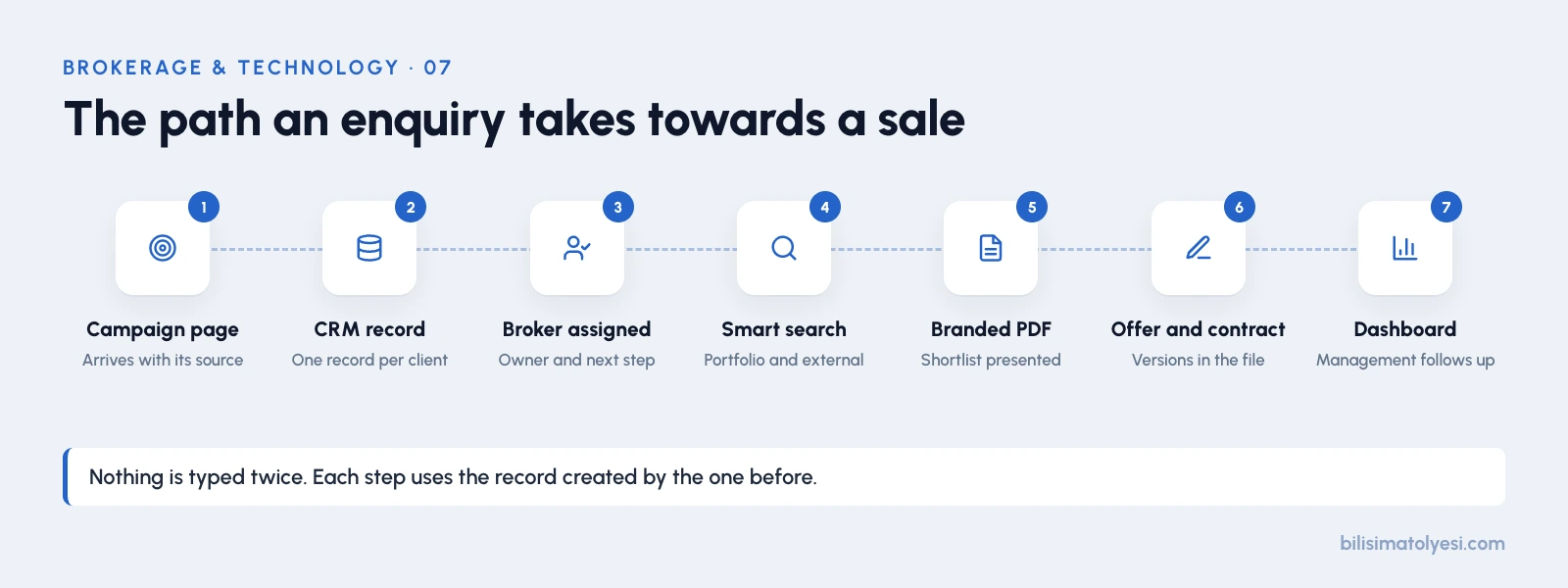
Consider an example. An enquiry arrives from a campaign page prepared for a boat show. It lands in the CRM with its source and is assigned to the right broker. Based on the client’s budget and requirements, the broker searches the company portfolio and external sources together, then sends three selected yachts as a branded PDF. Meeting notes and the offer build up in the same sales file, and management can see on the dashboard which campaign the enquiry came from and what stage it has reached.
Nothing in this flow is typed twice. The value of the systems comes less from their individual features than from their ability to pass data to one another.
Where should AI sit in this structure?
Rather than adding AI as a separate product, it makes more sense to place it inside the repetitive tasks of existing workflows. In a brokerage, the most useful areas are the following.
- Reading and summarising enquiries. It extracts budget, length, yacht type and timing from emails and messages in different languages and adds them to the CRM record as suggestions.
- Matching clients with yachts. It compares a client’s recorded requirements with yachts in the portfolio and data pool and gives the broker a short list of candidates with the reasons behind each.
- Cleaning external data. It maps differences in units, currencies and naming across listings from different platforms to a common structure and flags multiple listings of the same yacht.
- Meeting summaries and next steps. It summarises long meeting notes and reminds the broker of pending follow-ups and opportunities at risk of being forgotten.
- Content and document drafts. It prepares a first draft, in the brand’s voice, for yacht descriptions, PDF text, newsletters and social media posts.
- Asking questions of reports. A manager can ask questions such as “Which campaign led to the most meetings in the last three months?” directly of the dashboard data.
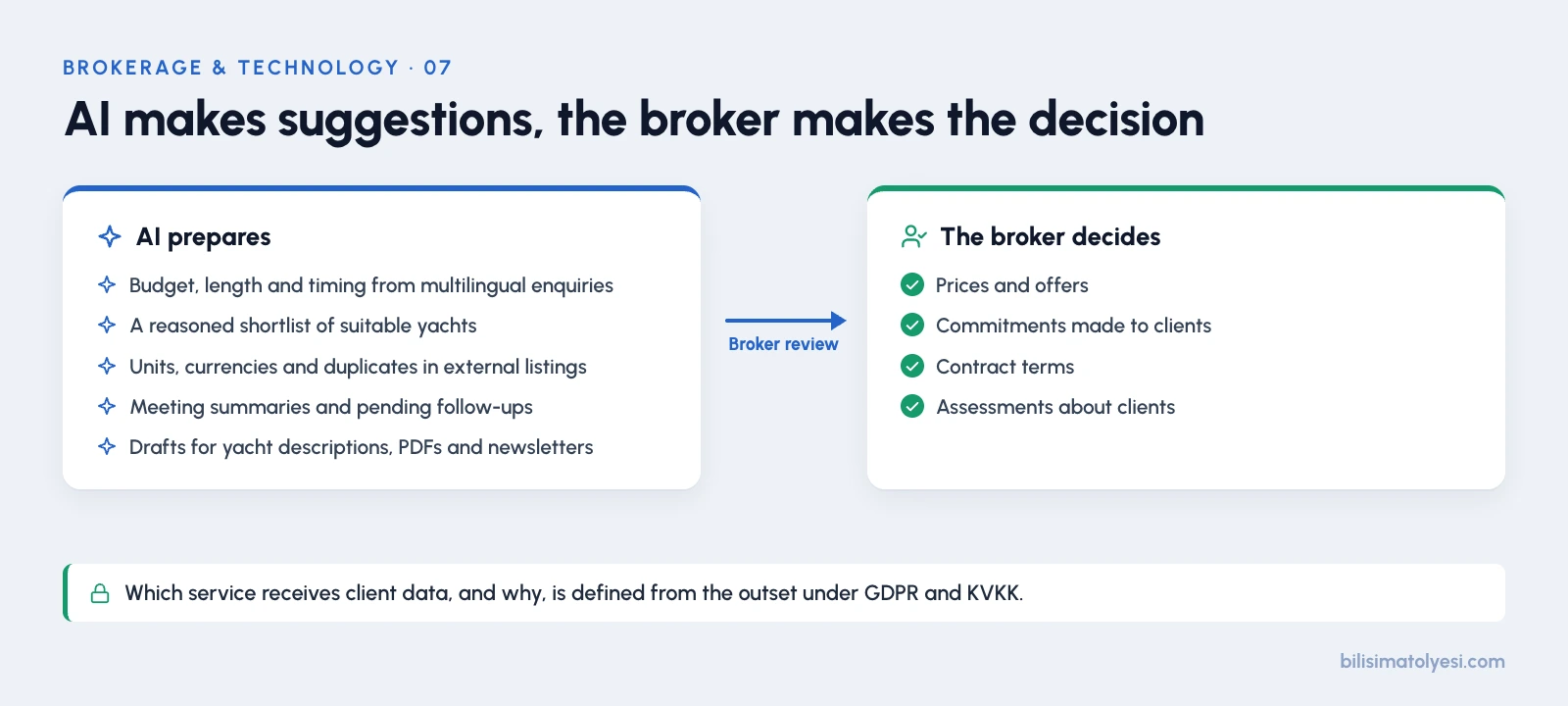
All of these uses share one boundary. AI produces suggestions, and the broker makes the decision. Information such as prices, commitments made to a client, contract terms or assessments about a client should not reach the record or the client without human approval.
Data needs care as well. Which AI service receives client information, for what purpose and within what limits should be defined from the outset in line with GDPR, KVKK and other applicable regulations. AI is also only as good as the order of the data beneath it. AI added on top of a disorganised CRM simply produces disorder faster.
Where to start?
There is no need to build every piece at once. For most brokerages, the right starting point is a CRM that gathers enquiries and client history, together with a portfolio managed in one place. The website, PDF generation and reporting deliver value much faster when they are added on top of these two foundations. AI can then be introduced as the data becomes organised, starting with the steps that waste the most time.
When you place your current tools into these layers, the points where information breaks down usually become clear on their own. Which enquiry is typed twice, which yacht detail is updated in three different places, which report is still prepared by hand every month? The answers also show where the first investment should go.
At Bilişim Atölyesi, we design CRM, portfolio, PDF and web infrastructure for yacht brokerages as one connected whole. You can read more about our approach on our Yacht Brokerage CRM page.